



It is 2:00 AM on a freezing winter night, and suddenly, the power in your home completely cuts out. You try flipping the switches, but nothing happens. A few minutes later, you notice an unsettling, acrid smell wafting from the hallway. Panic begins to set in. This is not a situation that can wait until morning. At a moment like this, your first instinct is likely to grab your smartphone and urgently type 24 hour electrician near me into the search bar. Best way to find the electrician near me.
Electrical emergencies are frightening, unpredictable, and potentially catastrophic if left unaddressed. Unlike a leaky faucet or a squeaky door, electrical failures carry immediate risks of severe property damage, structural fires, or even fatal electrocution. Knowing how to assess the situation safely, understanding what warrants an immediate call to a professional, and knowing how to find a trustworthy expert at any hour of the night are vital skills for every homeowner.
This comprehensive guide is designed to walk you through everything you need to know about navigating an after-hours electrical crisis. From identifying the early warning signs of an impending electrical fire to understanding the nuances of after-hours pricing, we will cover the entire spectrum of residential electrical safety.
Chapter 1: The Anatomy of an Electrical Emergency
The first and most critical step in managing a home electrical issue is determining its severity. Homeowners often grapple with deciding whether to pay a premium for immediate help or wait for normal business hours. Understanding the line between emergency vs scheduled electrical work can save you both money and stress, while ensuring your family remains safe.
What Constitutes an Electrical Emergency?
An electrical emergency is any situation that poses an immediate threat to your life, property, or the structural integrity of your home. If an issue creates a risk of fire, electrocution, or severe disruption to life-sustaining medical equipment, it is an emergency.
You need an emergency electrician immediately if you experience:
- Unexplained burning odors: Especially those resembling melting plastic or burning fish.
- Sparking or smoking outlets: Any visible smoke or continuous sparks.
- Water damage near electrical sources: Flooding that reaches outlets, panels, or large appliances.
- A hot electrical panel: If your breaker box is physically hot to the touch.
- Total power loss with no neighborhood outage: If your neighbors have power but your home is completely dark, and a main breaker reset does not fix it.
Scheduled Electrical Work: What Can Wait?
Conversely, scheduled electrical work involves upgrades, maintenance, and minor repairs that do not present immediate dangers. You can safely wait for standard business hours to address:
- Upgrading light fixtures or installing ceiling fans.
- A single dead outlet (provided it is not sparking, hot, or emitting an odor).
- Flickering lights when a high-wattage appliance turns on (though this should be inspected soon).
- Adding new circuits for future home expansions.
- Routine home electrical inspections.
Making this distinction is crucial. If a situation falls into the emergency category, hesitating out of concern for the cost can lead to devastating consequences. When in doubt, it is always safer to contact a local professional to describe your symptoms. Many reputable companies offer a quick phone consultation to help you determine if an immediate dispatch is necessary.
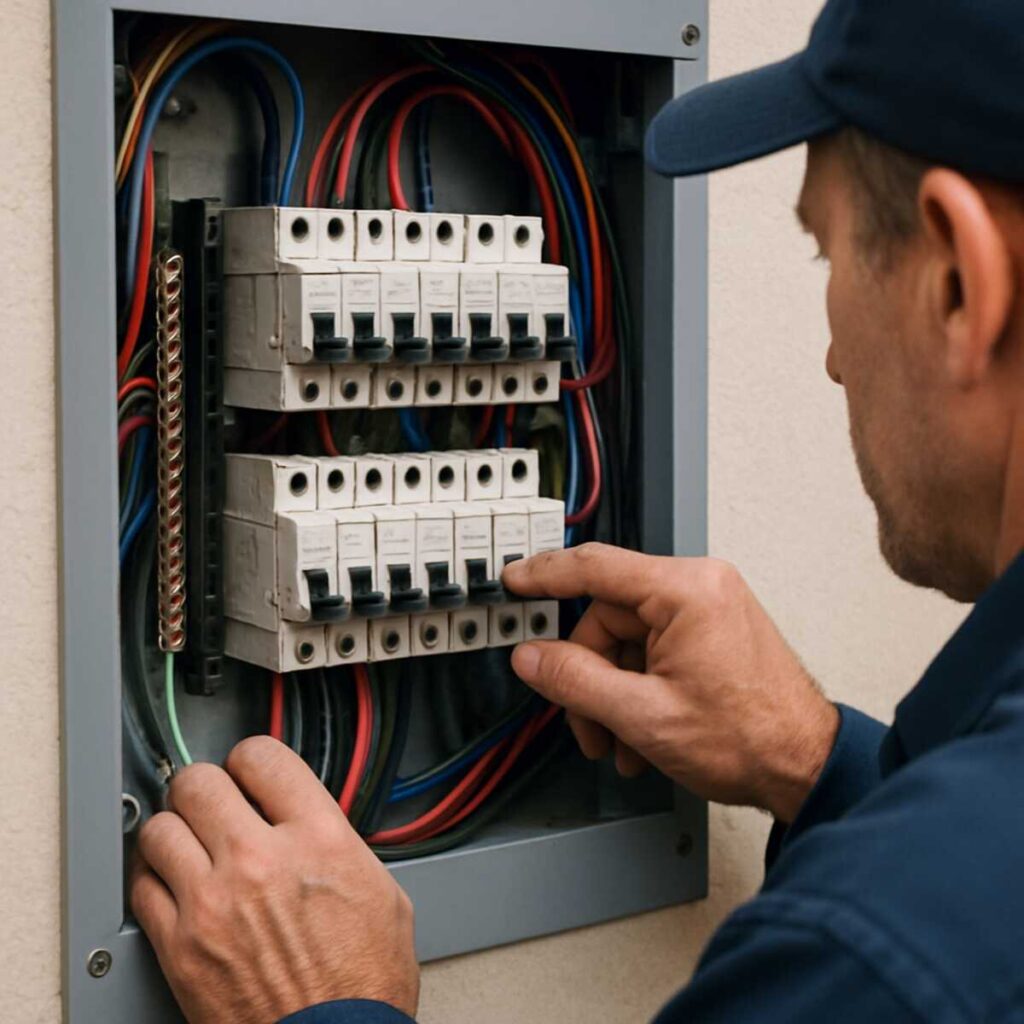
Chapter 2: Red Alert: Recognizing the Warning Signs
Electrical systems are designed to be invisible. Wires run behind drywall, under floors, and through attics. Because you cannot see the system, you must rely on your other senses—smell, hearing, and touch—to identify when something is going wrong. Paying attention to these early warning signs can prevent a minor fault from escalating into a full-blown residential fire.
1. The Burning Smell: Trust Your Nose
One of the most common and alarming signs of an electrical fault is an unusual odor. Identifying burning electrical smell early is critical. But what exactly does an electrical fire smell like?
Most modern electrical wires are coated in PVC (polyvinyl chloride) or other durable plastics. When a loose connection, overloaded circuit, or failing component generates excess heat, this plastic insulation begins to melt.
- The “Fishy” Smell: Strangely, melting electrical components often release chemicals that smell strongly of fish, urine, or ammonia. If you smell fish in your bedroom or living room and there is no logical explanation, check your outlets and switches immediately.
- The Acrid Plastic Smell: This is a sharper, more distinct odor of melting plastic or burning rubber.
If you detect these odors, turn off the power to that room at the breaker box immediately. Do not attempt to investigate behind the walls yourself. This is the exact moment you need to rely on certified on-call electrical technicians who have the thermal imaging tools and expertise to locate the overheating wire safely.
2. Sights and Sounds: When Outlets Act Up
Outlets should operate silently and without visual drama. If you are plugging in an appliance and see a brief, tiny blue spark, it may just be static or a normal arc as the connection is made. However, knowing exactly what to do when outlet sparks aggressively or continuously is vital for your safety.
Warning signs at the outlet level include:
- Continuous or large sparks: A large yellow or orange spark, accompanied by a “pop,” indicates a short circuit.
- Discoloration: Scorch marks, brown or black smudges, or melted plastic around the outlet slots.
- Buzzing or crackling sounds: These sounds indicate “arcing”—electricity jumping across a gap because of a loose wire. Arcing generates intense heat and is a leading cause of electrical fires.
Immediate Action for Sparking Outlets:
- Do not touch the outlet or the plug.
- Go to your circuit breaker panel.
- Turn off the specific breaker associated with that outlet.
- Call an emergency professional.
3. The Heart of the System: Panel Problems
Your electrical panel (or breaker box) is the brain of your home’s electrical system. It is designed to safely distribute power and physically trip (cut off) the flow of electricity if a circuit becomes overloaded.
You must be vigilant for overheated electrical panel warning signs. While a panel might feel slightly warm if you are running heavy appliances (like an HVAC system and an electric oven simultaneously), it should never be hot to the touch.
Watch out for:
- A panel that is hot to the touch: This indicates that breakers are failing to trip despite drawing too much current, or there is a loose master connection inside the box.
- Buzzing or humming from the box: A sign of a failing breaker or loose wiring.
- A burning smell emanating from the metal box.
- Rust or corrosion on the panel: Indicating moisture intrusion, which is a recipe for a catastrophic short circuit.
4. The Worst-Case Scenario: Fire
According to safety organizations, electrical failures are a leading cause of home fires. Being aware of the signs of residential electrical fire can give you the precious seconds needed to evacuate your family safely.
- Smoke coming from outlets or baseboards.
- Walls that feel hot to the touch.
- A popping sound originating from behind the drywall.
- Rapidly flickering lights followed by an intense burning smell.
If you suspect an active electrical fire, do not throw water on it. Water conducts electricity, and you could be lethally shocked. Evacuate the house immediately and call the fire department. Only after the fire is extinguished and the home is deemed safe to re-enter should you begin looking for a 24 hour electrician near me to assess and rebuild the damaged system.
Chapter 3: Diagnostics: Understanding Common After-Hours Faults
Not every late-night electrical issue involves fire or smoke. Sometimes, the problem is a baffling loss of power that leaves you confused and shivering in the dark. In these moments, basic troubleshooting can help you determine the severity of the issue and communicate effectively when you call a professional.
The Mystery of the Half-Dark House
One of the most confusing scenarios homeowners face is when the power goes out in only half of the house, or when heavy appliances stop working while the lights remain on. Troubleshooting partial power outages requires a basic understanding of how electricity enters your home.
Most residential homes are supplied with a “split-phase” electrical service. Two separate 120-volt lines come into your home from the utility company, providing a total of 240 volts for large appliances (like ovens and dryers), while splitting the 120-volt lines to power standard lighting and outlets across different “legs” of your breaker panel.
Why a partial outage happens:
- Utility Company Fault: One of the two main lines coming from the street transformer to your house has been damaged (e.g., by a fallen tree branch or a blown fuse on the utility pole). In this case, half the breakers in your panel lose power.
- A Tripped Main Breaker: Sometimes one leg of the main breaker trips internally.
- A Loose Neutral Wire: This is highly dangerous. If the neutral wire returning to the utility fails, voltage can wildly fluctuate, sending 240 volts to a 120-volt outlet and destroying your electronics.
What to do: First, check with your utility company to see if there is an area-wide “brownout” or phase loss. If the utility company confirms their lines are functioning perfectly, the issue is inside your home, and you need an emergency electrician to investigate your main panel.
Dealing with Main Breaker Issues
Sometimes, your entire house loses power, but the streetlights and your neighbors’ houses are glowing brightly. You check your panel, and the large switch at the very top (or bottom)—the main breaker—has flipped to the “off” or middle position.
Finding a safe tripped main circuit breaker solution is something you can attempt, but it must be done with extreme caution. The main breaker shuts off the entire electrical supply to the branch circuits in your home. If it trips, it usually means the total electrical load of the house exceeded the panel’s capacity, or there is a massive short circuit.
How to safely reset a main breaker:
- Turn off all individual branch circuit breakers first. (This prevents a massive power surge from hitting all your appliances at once when the main power is restored).
- Firmly push the main breaker all the way to the “OFF” position. (Breakers must be fully turned off before they can be reset).
- Firmly push the main breaker to the “ON” position.
- Begin turning on the individual branch breakers one by one, waiting a few seconds between each.
If the main breaker instantly trips again the moment you flip it, or if it trips when you turn on a specific branch circuit, stop immediately. Do not force the breaker to stay on. Forcing a breaker to stay engaged defeats its safety mechanism and can instantly start a fire. At this point, it is time to call in a professional.
Chapter 4: The Search: Vetting a 24-Hour Electrician
When you are plunged into darkness at 3:00 AM, the urgency to resolve the problem is immense. However, hiring the wrong person in a panic can result in shoddy workmanship, inflated bills, and unresolved safety hazards. Knowing how to quickly and efficiently vet a local electrician during an emergency is an invaluable skill.
The Power of Local Search
When searching for a 24 hour electrician near me, your geographic location plays a massive role in how quickly your issue can be resolved. While large, national chain home-service companies have massive advertising budgets and 24-hour call centers, they may not actually have a technician available in your specific zip code at that exact moment.
A well-established local electrician often provides faster, more personalized service. Local companies rely heavily on their community reputation, making them highly motivated to provide honest, efficient service, even in the dead of night. Furthermore, a local professional is already intimately familiar with the specific building codes, older home architectures, and common weather-related electrical issues specific to your region.
Evaluating Average Emergency Response Times
When dealing with an active spark or a freezing home without power, time is of the essence. When you connect with a dispatcher or an on-call technician, explicitly ask about their average emergency response times.
- Standard Emergency Response: A reputable emergency electrical service should typically have a technician at your door within 1 to 2 hours of your call, depending on your proximity to city centers or rural areas.
- The “We’ll put you on the schedule for tomorrow” Red Flag: Some companies advertise 24-hour service, but what they actually mean is they have a 24-hour answering service. If the dispatcher tells you a technician will arrive “first thing in the morning,” they are not providing true emergency service. Do not hesitate to hang up and call the next company on your list if your situation is critical.
Quick Vetting Checklist During a Panic
Even when you are stressed, take two minutes to ensure the person you are inviting into your home in the middle of the night is legitimate.
- Check Reviews Quickly: Look at their Google or Yelp rating. Sort by “Newest” to see how they have performed recently.
- Verify Licensing Over the Phone: Ask the dispatcher, “Is the technician being sent fully licensed and insured?”
- Ask About the Dispatch Fee: Legitimate companies will be transparent about their after-hours call-out fee before they send a truck.
- Look for Branding: When the technician arrives, they should ideally be in a clearly marked company vehicle and wear an identifiable uniform or badge.
Chapter 5: Credentials Matter: Who is Knocking at Your Door?
Electricity is unforgiving. A plumber’s mistake might lead to a flooded basement, but an electrician’s mistake can burn a house down. Because the stakes are so high, the electrical trade is highly regulated. When searching for emergency help, understanding the professional tiers and credentials of electrical workers is crucial.
The Journey to Mastery: Licensed Master Electrician Requirements
Not all electricians have the same level of training. The title of “Master Electrician” is not given lightly; it represents the pinnacle of the profession. Understanding licensed master electrician requirements helps you appreciate the level of expertise you are paying for.
While requirements vary slightly by state and municipality, the general path to becoming a Master Electrician involves:
- Apprenticeship: This involves typically 4 years (or 8,000 hours) of supervised, on-the-job training alongside hundreds of hours of classroom instruction learning electrical theory, mathematics, and the National Electrical Code (NEC).
- Journeyman License: After completing the apprenticeship, the worker must pass a rigorous state-level examination to become a Journeyman Electrician. A Journeyman can work independently but typically cannot pull major permits or own an electrical contracting business.
- Master Electrician Certification: To achieve Master status, a Journeyman must work in the field for an additional 2 to 4 years (often roughly 4,000 hours) and pass an incredibly comprehensive Master’s exam. This exam tests deep knowledge of complex system design, advanced NEC codes, business law, and safety protocols.
When a company sends a Master Electrician—or a Journeyman operating under the direct license of a Master Electrician—you are getting someone with nearly a decade of formal training. This level of expertise allows them to quickly and safely diagnose a complex, hidden fault at 2:00 AM.
The Importance of Certified On-Call Electrical Technicians
In emergency scenarios, you specifically want to ensure the company utilizes certified on-call electrical technicians. Certification goes beyond just basic licensing. It often includes:
- Up-to-date CPR and first-aid training.
- OSHA safety certifications (such as OSHA 10 or OSHA 30).
- Specific certifications for specialized equipment, such as thermal imaging cameras used to find overheating wires behind walls.
- Rigorous background checks and drug testing, providing you peace of mind when allowing a stranger into your home after hours.
Do not be afraid to politely ask the technician for their license number when they arrive. A proud, legitimate professional will gladly produce it.
Chapter 6: The Financial Factor: Pricing After-Hours Work
One of the primary reasons homeowners hesitate to call for emergency help is the fear of exorbitant costs. It is no secret that an after-hours call will cost more than a scheduled Tuesday morning appointment. However, understanding how these prices are structured can alleviate anxiety and help you avoid being taken advantage of by unscrupulous contractors.
Deconstructing Emergency Electrical Repair Costs
The final bill for an emergency repair is rarely a flat rate. Emergency electrical repair costs are generally composed of three distinct elements: the trip fee, the labor rate, and the cost of materials.
- The Dispatch/Trip Fee: Simply getting a technician out of bed, into a fully stocked truck, and to your doorstep carries a premium. This fee usually ranges from $100 to $300, depending on your location. This fee is often just to assess the problem and does not include the actual repair labor.
- The Labor Rate: Once the technician identifies the problem, you will be quoted for the labor. In emergencies, this is often calculated at “time-and-a-half” or “double-time.”
- Materials and Parts: If your repair requires a new breaker, replacement wiring, or a new outlet receptacle, you will be charged for these parts. Keep in mind that emergency technicians carry “rolling warehouses” in their trucks, and you are paying a slight premium for the convenience of having the necessary parts immediately available in the middle of the night.
Navigating After-Hours Electrical Service Rates
When calling around, transparency is key. After-hours electrical service rates can vary wildly between companies. Here is how to navigate the financial conversation during an emergency:
- Ask for the “Show Up” cost: Clearly ask, “How much will it cost just to have the technician arrive at my house and diagnose the problem?”
- Beware of “Too Good to be True” rates: If a company promises a $29 after-hours dispatch fee, be highly skeptical. Unethical companies use incredibly low dispatch fees to get their foot in your door, only to aggressively up-sell you or invent massive, expensive problems once they arrive.
- Request an Upfront Quote: Once the technician diagnoses the issue, a reputable company will provide a clear, upfront quote for the repair before any tools are used. This “flat-rate pricing” model protects you from a slow-working technician racking up hourly charges.
A realistic expectation: A simple after-hours fix, such as replacing a fried breaker or fixing a single sparking outlet, may cost anywhere from $250 to $600 in total. However, if your entire electrical panel has melted down and needs emergency replacement, the costs can escalate into the thousands.
How to Prevent Invoice Shock
While you cannot predict every expense, you can control the situation. Ask the electrician to secure the immediate safety hazard first. For example, if an outlet is sparking, the emergency technician can safely disconnect and cap the wires, rendering the area safe. You can then schedule the actual wall repair and outlet replacement for normal business hours, saving you money on the premium labor rates. The goal of an emergency call is safety first, aesthetics and full restoration second.
Chapter 7: Ground Zero: Safety Protocols While You Wait
You have assessed the situation, determined it is an emergency, and searched for a 24 hour electrician near me. You have vetted a local company, agreed to the dispatch fee, and the technician is en route.
What do you do now? The time between your phone call and the professional’s arrival is a critical window. Adhering to a strict emergency electrical safety protocol is essential to keep your family and property safe.
Immediate Action Steps
- Do Not Touch the Affected Area: If an appliance, outlet, or switch is smoking, smelling, or sparking, step away. Do not attempt to unplug the device. Your body is an excellent conductor of electricity, and touching a compromised electrical housing can result in a lethal shock.
- Kill the Power at the Source: If it is safe to do so, go to your main breaker panel. If you know exactly which breaker controls the affected area, turn it off. If you are unsure, or if the panel is sparking or hot to the touch, do not touch the panel. Evacuate the house instead.
- Clear the Area: Move family members and pets away from the danger zone. If there is a risk of fire, close the door to the affected room to help contain potential smoke or flames.
- Prepare for the Electrician: Ensure the pathway to your electrical panel is clear. Move boxes, bicycles, or furniture that might be blocking access to the breaker box. The technician will need immediate, unobstructed access to diagnose the issue quickly.
- Gather Flashlights: Do not light candles during an electrical outage, especially if the outage is combined with unknown smells. Candles introduce an open flame hazard into an already volatile situation. Rely strictly on battery-powered flashlights or the flashlight function on your smartphone.
Navigating Outages: Backup Generator Safety Tips
If your emergency involves a total power loss during extreme weather—such as a deep winter freeze or a blistering summer heatwave—you might rely on a portable backup generator to keep critical systems (like refrigerators or space heaters) running while you wait for the repair.
However, improper generator use can be more dangerous than the power outage itself. Adhere to these critical backup generator safety tips:
- The Carbon Monoxide Threat: Never run a portable generator inside your home, garage, basement, or even a partially enclosed porch. Generators produce massive amounts of carbon monoxide (CO), an odorless, colorless gas that can be fatal in minutes. Always place the generator at least 20 feet away from your home, directing the exhaust away from windows and doors.
- The Danger of Backfeeding: Never attempt to power your home by plugging a generator directly into a standard wall outlet. This illegal and incredibly dangerous practice is known as “backfeeding.” It sends electricity backward through your home’s wiring and out into the utility grid. This can easily electrocute a utility worker who is trying to repair the lines down the street.
- Proper Connections: Only plug appliances directly into the generator using heavy-duty, outdoor-rated extension cords. If you want a generator to power your whole home safely, you must have a licensed electrician install a dedicated “transfer switch” during normal business hours.
- Fueling Safety: Never refuel a generator while it is running or still hot. Turn it off and let the engine cool completely to avoid igniting spilled gasoline.
By following these protocols, you ensure that the situation remains under control until the cavalry—your certified emergency electrician—arrives to permanently resolve the issue.
Chapter 8: Future-Proofing: Your Ultimate Prevention Guide
Surviving an after-hours electrical crisis is a relief, but the best emergency is the one that never happens at all. Once the immediate danger is resolved and your home is safe, it is time to shift your focus from reaction to prevention. Implementing a comprehensive electrical hazard prevention guide will protect your home, extend the life of your appliances, and ensure you never have to make a panicked late-night phone call again.
The Importance of Routine Electrical Inspections
Electrical systems age just like plumbing or roofing. Wires expand and contract with temperature changes, insulation degrades over decades, and modern technology places incredibly high demands on older electrical panels.
You should schedule a professional, non-emergency electrical inspection if:
- Your home is more than 25 years old and has never been upgraded.
- You have recently purchased a pre-owned home.
- You have added major new appliances (like an EV charger, hot tub, or new HVAC system).
- Your home still utilizes knob-and-tube wiring or aluminum wiring (common in the 1960s and 70s), both of which present significant fire risks.
During a scheduled inspection, a licensed professional will open panels, test the grounding systems, verify that GFCI (Ground Fault Circuit Interrupter) and AFCI (Arc Fault Circuit Interrupter) breakers are functioning, and tighten all critical connections. Loose connections are the primary cause of arcing and subsequent electrical fires; tightening them is a low-cost preventative measure.
Modernizing Your Electrical Panel
Many electrical emergencies stem from an outdated electrical panel that is simply overwhelmed by the demands of modern life. If you live in an older home with a 60-amp or 100-amp service, your panel is working in overdrive just to run your computers, televisions, microwaves, and air conditioners.
Consider upgrading to a 200-amp service. While this is an investment, it completely eliminates the risk of an overloaded main panel and provides peace of mind. Furthermore, ensure your panel is equipped with modern AFCI breakers, which actively monitor the circuit for the dangerous arcing conditions that lead to sparking outlets and hidden wall fires.
Daily Habits for Electrical Safety
Preventative maintenance is not just about hiring professionals; it is about adopting safe daily habits. Incorporate these practices into your home life:
- Respect the Power Strip: Power strips and surge protectors are designed for low-draw electronics like TVs and computers. Never plug high-heat appliances like space heaters, slow cookers, toasters, or microwaves into a power strip. They draw too much continuous current, which will eventually melt the power strip and cause a fire. Plug these directly into wall outlets.
- Monitor Your Cords: Routinely inspect the cords of your lamps, vacuums, and chargers. If you see exposed wire, fraying, or chew marks from pets, throw the item away or have the cord professionally replaced. Never run cords under rugs or heavy furniture, as the friction and weight can damage the internal wires and start a hidden fire.
- Upgrade Outlets Near Water: Ensure every outlet in your kitchen, bathroom, laundry room, and exterior is a GFCI outlet. These outlets feature the “Test” and “Reset” buttons and are designed to instantly cut power if electricity comes into contact with water, saving you from severe electrocution.
- Listen to Your Breakers: If a specific circuit breaker trips frequently (e.g., every time you vacuum while the TV is on), do not ignore it. The breaker is doing its job by protecting the wire from overheating. Continually resetting a tripping breaker degrades its internal mechanisms. Have an electrician split the load onto a new, dedicated circuit.
Conclusion: Peace of Mind in the Dark
An unexpected electrical failure in the middle of the night is an undeniable source of immense stress. The sudden darkness, the strange odors, and the fear of a potential fire are enough to unsettle even the most composed homeowner. However, equipped with the knowledge in this guide, you are no longer at the mercy of the unexpected.
You now know how to differentiate between a minor nuisance and a true, life-threatening emergency. You understand the red flags—from the ominous fishy smell of melting plastic to the frightening pop of a sparking receptacle. More importantly, you know exactly how to safely manage the situation while you secure professional help.
When the time comes to urgently search for a 24 hour electrician near me, you are prepared. You know how to bypass the national call centers and find a reputable, local expert. You understand the value of verifying licensed master electrician credentials, and you have a realistic grasp of the emergency electrical repair costs and dispatch fees involved.
Ultimately, your home’s electrical system should be a silent, invisible servant, reliably powering your life without drama. By respecting the dangers of electricity, utilizing certified professionals for both emergencies and routine upgrades, and adhering strictly to safety protocols, you can ensure that your home remains a safe, brightly lit sanctuary for you and your family—no matter what hour of the night it is. Keep a trusted local emergency electrician’s phone number saved in your contacts today; you will be profoundly grateful for it when you need it most.