


Understanding the Rules of Mille Bornes
Welcome to Mille Bornes, the classic card game where the finish line is everything. The objective is to be the first person to travel exactly 1,000 miles, navigating a winding road of luck, strategy, and a little roadside sabotage. To learn more, check out mpbsnacks.com
Your hand of cards provides all the tools you’ll need. The deck is broken into four categories: Distance cards move you toward the finish line, Hazard cards are problems you play on opponents, Remedy cards fix those problems, and Safety cards offer permanent protection.
Every turn boils down to a choice: advance your own position or slow an opponent. Mastering Mille Bornes is about knowing when to step on the gas and when to cause a traffic jam for everyone else. This guide will get you from the garage to the open road in minutes.
First Things First: How to Set Up Your Game and Deal the Cards
To begin, one person shuffles the 110-card deck and deals six cards, face down, to every player. Keep your hand hidden from your opponents.
Place the remaining stack of cards face down in the center of the table to form the Draw Pile. Leave an open space next to it for a Discard Pile.
Finally, each player needs space for two separate piles in front of them: a Distance Pile for mileage cards and a Battle Pile for action cards, such as playing a “Go” card or receiving a Hazard.
What Do I Do On My Turn? The Simple “Draw 1, Play 1” Rule
The player to the left of the dealer goes first. Every turn follows a simple rhythm: draw one card from the Draw Pile, bringing your hand to seven, then choose one card to play or discard.
Your goal is to play a card. If it helps you—like a Distance card or a Remedy—place it on the correct pile in front of you. If it hurts an opponent—like a Hazard card—play it onto their Battle Pile. This is how you attack and defend in the race.
If you cannot make a legal move or have a card you don’t want, you must discard one card from your hand face-up onto the Discard Pile. Your turn is then over.
How to Start Moving: The All-Important “Go” Card
Before you can play any mileage cards, you must get your car on the road by playing a green Go card (sometimes labeled Roll) onto your Battle Pile. As long as this card is on top, your car is “moving,” and you are free to play Distance cards.
Your opponents can halt your progress by playing a red Stop card on your Battle Pile, covering your Go card. To get moving again, you must play a new Go card on a future turn. Only then can you resume your journey.
Getting stopped by a specific problem, like an Out of Gas or Flat Tire card, is more complicated. You must first play the corresponding Remedy card. Then, on a later turn, you must play a Go card to start moving again. Fixing a problem and getting moving are two separate actions.
How to Score Points: Playing Distance Cards to Reach 1000 Miles
Once your engine is running with a “Go” card, you can play Distance cards to score points. These come in five values: 25, 50, 75, 100, and 200 miles. Play one from your hand onto your Distance Pile to add its value to your total.
While the 200-mile card is the fastest way to get ahead, there’s a major restriction: you are only allowed to play a maximum of two 200-mile cards during a single hand. Trying to play a third is against the rules.
Finally, you must reach exactly 1000 miles to win; you cannot go over. If your total is 950 miles, playing a 100-mile card is an illegal move. You would need to wait until you draw a 50-mile card to hit the target perfectly. This rule makes the end of every hand especially tense.
How to Sabotage Your Opponents with Hazard Cards
Sometimes the best move is to throw a wrench in an opponent’s plans using Hazard cards. You can only play one on an opponent who currently has a green “Go” card showing. You can’t, for example, give a flat tire to a car that is already stopped.
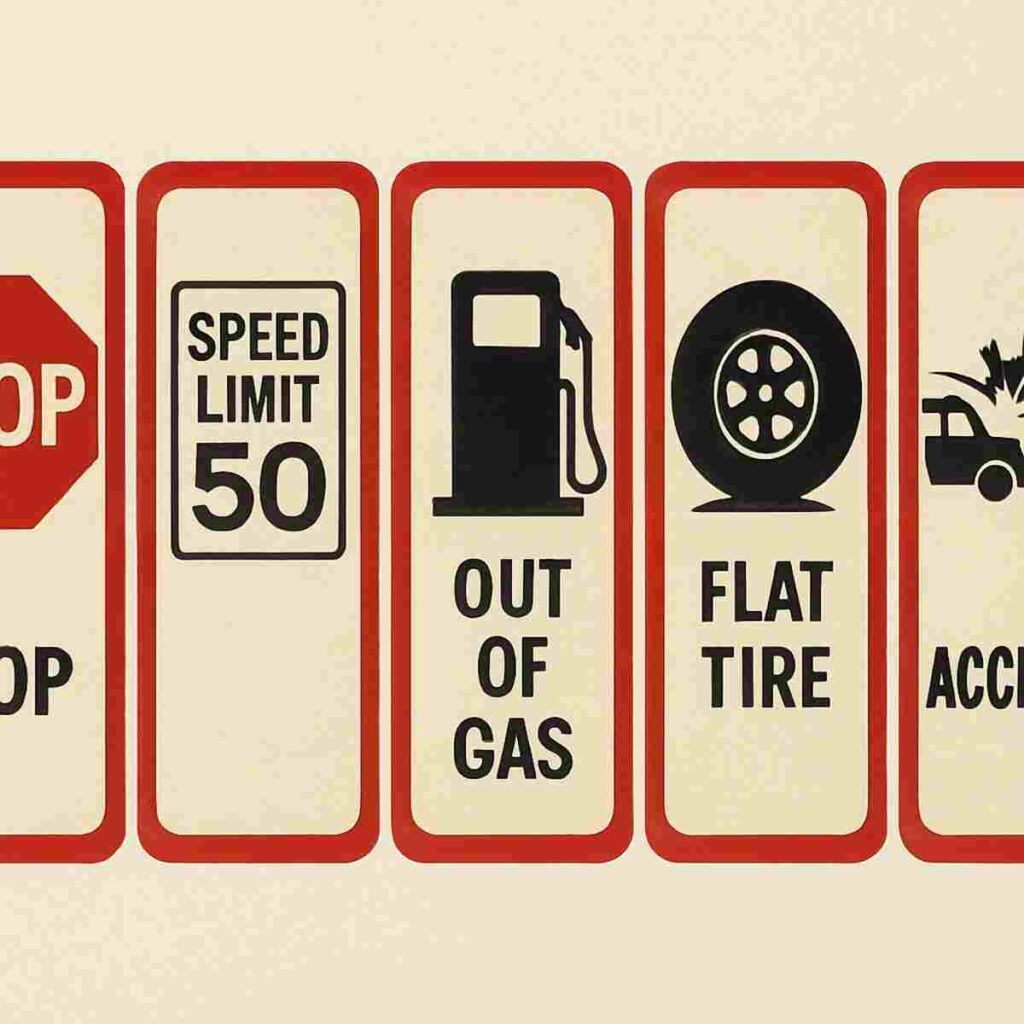
Most hazards bring an opponent to a dead stop. An Accident, Flat Tire, or Out of Gas card creates a specific problem they must fix before they can move again. The simple Stop card also halts their progress.
The Speed Limit card works differently—it doesn’t stop your opponent, just slows them down. A player under a speed limit can still drive, but they can only play 25 or 50-mile cards until the limit is lifted. Every hazard has a specific solution, which is key to getting back in the race.
Fixing the Problem: How to Use Remedy Cards to Get Moving Again
Every Hazard card has a matching Remedy card with a green border. When an opponent plays a Hazard on you, you must fix it by playing the correct Remedy card on your own pile. The pairings are direct and easy to remember:
- An Accident is fixed by Repairs.
- A Flat Tire is fixed by a Spare Tire.
- An Out of Gas card is fixed by Gasoline.
- A Speed Limit is fixed by an End of Limit.
- A Stop sign is fixed by a Go card.
For major problems like an accident or flat tire, playing the Remedy is only the first step. For example, if you get a flat, you would play a Spare Tire card on your turn. Your car is now fixed, but it’s still stopped. On your next turn, you must play a Go card to get moving again before you can start playing Distance cards. Wouldn’t it be better to avoid these problems entirely? That’s where Safety cards come in.
Your Ultimate Protection: How to Use Safety Cards
While Remedy cards fix problems, Safety cards prevent them from ever happening again. These four special cards provide permanent immunity for the rest of the hand. Once you play a Safety card, you can no longer be affected by its corresponding Hazard.
- Puncture-Proof makes you immune to Flat Tires.
- Driving Ace prevents Accidents.
- Fuel Tank ensures you never run Out of Gas.
- Right of Way grants immunity to both Stop signs and Speed Limits.
Beyond providing immunity, playing a Safety also acts as a Go card. If you were stopped, you can play the matching Safety to become immune and get moving again on the very same turn. If you have a Safety in your hand when an opponent plays the matching Hazard on you, you can instantly counter their move for a huge point bonus in a play known as a Coup-Fourré.
What is a Coup Fourré? Scoring This Powerful Expert Bonus
The Coup-Fourré (pronounced “koo-foo-RAY”) is a thrilling “gotcha” moment in Mille Bornes. It occurs when you use a Safety card from your hand to instantly counter an opponent’s attack. For example, if someone plays a “Flat Tire” on you and you have the “Puncture-Proof” Safety in your hand, you can immediately reveal it.
As your opponent plays the Hazard, you declare “Coup-Fourré!” and place your Safety card in your play area. Their Hazard is discarded, having no effect. You are now permanently immune and immediately draw a replacement card before continuing your normal turn. This powerful counter scores a massive 300-point bonus at the end of the hand.
The Safety card must be in your hand before your opponent makes their move to qualify for the bonus. This makes holding a Safety a risky but potentially rewarding strategy that can easily make the difference in a close race.
Crossing the Finish Line: How to Win a Hand of Mille Bornes
The moment a player lays down a Distance card that brings their total to exactly 1000 miles, the hand is over. That player is the winner of the hand and earns a special “Trip Completed” bonus.
If the draw pile runs out before anyone reaches the goal, play continues with the cards left in each player’s hand. The hand ends when a full round occurs where no player can make a legal move. After the hand ends, it’s time to tally the points.
How to Count Your Points: A Simple Guide to Scoring a Hand
Once the hand is over, everyone who traveled gets to score points. Your score is the number of miles you drove plus any bonuses you earned. Keep a running total, as the first player to reach 5,000 points wins the entire match.
Add up the following from your play area:
- Miles Driven: 1 point for every mile on your Distance cards.
- Each Safety Card Played: 100 points.
- All 4 Safeties Played: An extra 300-point bonus (for 700 total points from Safeties).
- Trip Completion Bonus: 400 points for the player who finished the 1,000-mile trip.
- Shutout Bonus: 500 points if you completed the trip after the draw pile was empty and other players had no cards left to play.
- Each Coup-Fourré: 300 points for each time you used a Safety to block a Hazard immediately.
Your Next Road Trip: Winning the Race and Answering Common Questions
You now have the keys to start your engine, navigate hazards, and race toward that 1,000-mile finish line. Winning a single hand is just the first leg of the trip; the ultimate goal is to be the first to accumulate 5,000 points.
As you play, you’ll discover simple winning strategies, like saving 200-mile cards for the final stretch or holding a Safety to execute a Coup-Fourré. The rules are the same for two players, making for an intense head-to-head race. And unlike Uno, the goal in Mille Bornes is to build a high score by traveling miles, not to empty your hand.
So shuffle the deck, deal the cards, and embrace the journey. The real fun is in the flat tires, sudden green lights, and thrilling overtakes along the way. Enjoy the ride.