

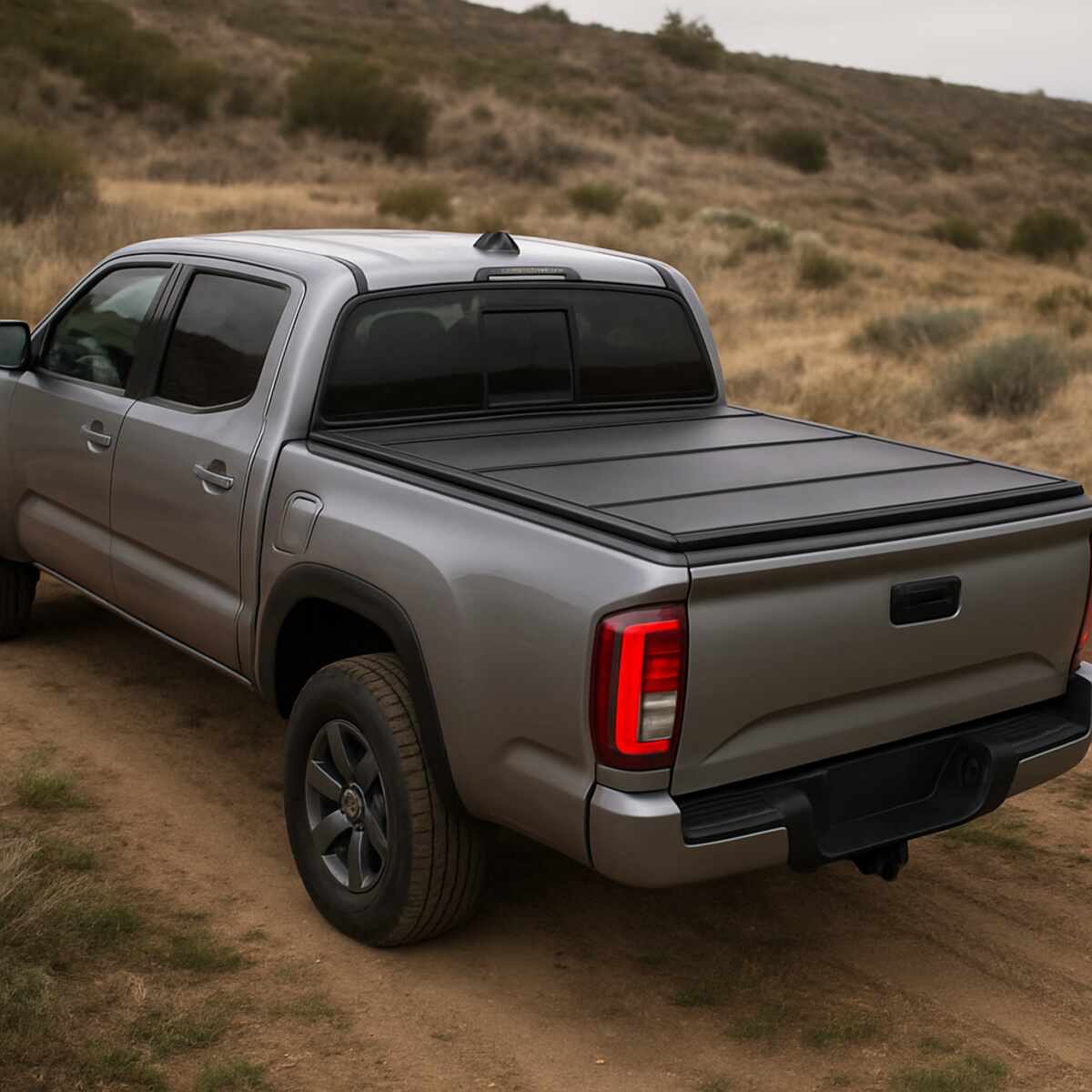
Whether you use your truck for hauling heavy construction materials, escaping for weekend camping trips, or simply making the daily grocery run, optimizing your cargo space is paramount. One of the best investments you can make for your pickup is a high-quality bed cover. However, stepping into the aftermarket accessories world can feel overwhelming. You are immediately hit with an endless array of options, styles, and mechanisms, leading to the ultimate modern debate: the Tri-Fold vs Flipback Quad-Fold Tonneau Cover. Select the best quad fold tonneau cover.
Choosing the right truck bed cover is about more than just aesthetics. It dictates how you interact with your truck every single day. From protecting expensive tools from the elements to ensuring you have the necessary clearance to tow a massive fifth-wheel RV, the cover you select must match your lifestyle.
In this comprehensive guide, we will break down everything you need to know about these two titan styles of folding covers. We will explore the nuances of design, material durability, weather resistance, and security, helping you make an informed decision for your rig.
The Evolution of the Tonneau Cover
Before we dive into the specifics of folding mechanisms, it helps to understand why the modern tonneau cover has evolved into the sophisticated accessory it is today. Historically, truck covers were simple pieces of canvas snapped over the bed. They were frustrating to install, shrank in the cold, and offered zero security.
Today’s covers are engineering marvels. They feature heavy-duty extruded aluminum rails, automotive-grade weather stripping, and intuitive latching mechanisms. As truck owners demanded more versatility—wanting secure storage one minute and an open bed for hauling a refrigerator the next—manufacturers responded with folding designs. The folding cover revolutionized the market by offering a perfect blend of hard-shell security and soft-cover flexibility.
Deep Dive: The Tri-Fold Tonneau Cover
The tri-fold tonneau cover is arguably the most popular style on the market today, and for good reason. As the name suggests, this cover is divided into three equal panels. When you need access to your bed, you unlatch the tailgate, fold the rear panel over the middle panel, and then fold both over the front panel near the cab.
Why Truck Owners Love the Tri-Fold
- Simplicity and Speed: Operating a tri-fold cover takes seconds. The hinges are pre-assembled, and the folding action is natural.
- Ease of Installation: Many tri-folds come fully assembled in the box. You simply square it up on your bed rails, tighten a few hand clamps, and you are ready to go.
- Versatility in Materials: You can find tri-folds in virtually every material, from budget-friendly soft vinyl to heavy-duty aluminum.
The Limitation: Partial Bed Access
The primary drawback of a standard tri-fold cover is that it typically only allows access to two-thirds of your truck bed. Because the front panel remains stationary (clamped to the bed rails near the cab), the folded panels stack on top of it. If you need to haul a dirt bike, an ATV, or a large piece of furniture that requires the entire length of the bed, a traditional tri-fold can be limiting.
To haul oversized items, you often have to remove the cover entirely. Fortunately, removing folding covers for oversized cargo is usually a quick process with a standard tri-fold, requiring you to loosen the two front clamps and lift the unit off. However, you then have to figure out where to store the cover while you haul your load.
Deep Dive: The Flipback Quad-Fold Tonneau Cover
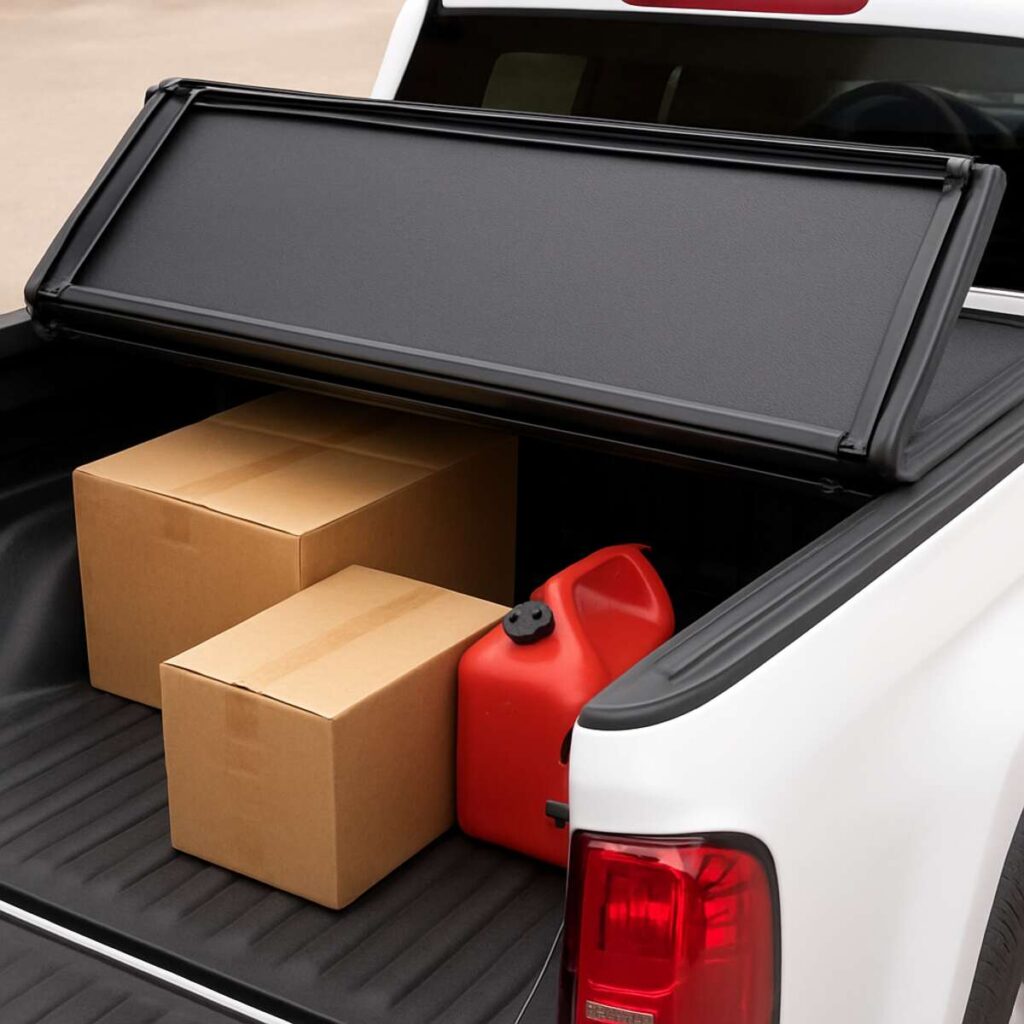
To solve the partial bed access issue inherent in standard tri-folds, engineers developed the flipback quad-fold (often just called a hard folding cover with full bed access). This design features four smaller panels or three large panels with a specialized hinge that allows the entire assembly to flip up vertically against the back of the truck cab.
The Ultimate Advantage: 100% Bed Access
When discussing full bed access truck covers, the flipback quad-fold is the undisputed king. You get the security of a hard cover when closed, but when you need your entire bed, you simply fold the panels all the way up and secure them with integrated prop rods. You do not have to remove the cover to haul a dirt bike; the bed is completely open and ready for action.
Does a Quad-Fold Cover Block the Back Window?
This is the most common question buyers ask when considering this style. The short answer is: yes. When a flipback quad-fold is locked in its fully open, vertical position against the cab, it will block your rear window. You will lose visibility through your rearview mirror and will need to rely entirely on your side mirrors and backup camera.
For some drivers, this is a minor inconvenience compared to the utility of having full bed access. For others, particularly those who frequently tow heavy loads and like to keep an eye on their cargo through the back glass, this can be a dealbreaker.
Protecting Your Truck While Open
If the cover is leaning against the truck cab, won’t it scratch the paint? Manufacturers have anticipated this. High-quality flipback models feature robust cab protection during full bed access. This usually comes in the form of thick rubber bumpers or foam pads integrated into the top panel. When the cover is flipped up, these bumpers rest gently against the cab or the rear glass, preventing scratches, dents, and rattling while you drive down the highway. Additionally, rigid prop rods lock the cover securely in place so wind cannot slam it against your truck.
The Showdown: Tri-Fold vs Flipback Quad-Fold Tonneau Cover
When comparing the Tri-Fold vs Flipback Quad-Fold Tonneau Cover, there is no objective “best” choice—only the best choice for you. Here is a breakdown of how they compare across key lifestyle categories.
1. Hauling Large Appliances and ATVs
Winner: Flipback Quad-Fold If you regularly haul tall items that require the full length of the bed, the quad-fold wins easily. Propping the cover against the cab takes five seconds, whereas removing a standard tri-fold takes a few minutes and requires garage storage space.
2. Rear Visibility
Winner: Standard Tri-Fold Because the standard tri-fold sits flat on the rails at the front of the bed, it never obscures your rear window. You maintain a clear line of sight through your rearview mirror, which is safer and more comfortable for many drivers.
3. Ease of Removal
Winner: Standard Tri-Fold If you prefer to just take the cover off completely when doing serious hauling, standard tri-folds are generally lighter and easier to pop off by undoing two hand clamps. Quad-folds are bolted directly to a track system mounted on your bed rails, requiring tools to remove completely.
4. Towing a Fifth Wheel
Winner: Flipback Quad-Fold If you are looking for the best truck bed cover for fifth wheel towing, you need maximum clearance near the cab to allow the trailer to articulate without crushing the cover. Because standard tri-folds leave a stacked panel covering the front third of the bed, they often interfere with the pin box of a fifth wheel during tight turns. A flipback quad-fold opens up the entire bed, giving you the necessary clearance to tow safely.
Material Matters: Choosing the Right Build
The mechanism is only half the battle; the material your cover is made from determines its longevity, security, and aesthetics. The market generally splits into soft covers and hard covers, with hard covers further dividing by material type.
Soft Vinyl vs Hard Panel Folding Covers
When evaluating soft vinyl vs hard panel folding covers, it comes down to budget versus security.
Soft Vinyl Covers:
- Pros: Highly affordable, lightweight, incredibly easy to install and remove. They provide excellent shade and decent rain protection for your cargo.
- Cons: They offer virtually zero security. A thief with a pocketknife can slice through a vinyl cover in seconds. Over time, soft vinyl can stretch, fade, and flap in the wind at highway speeds, creating irritating noise.
Hard Panel Covers:
- Pros: Superior security, sleek aesthetics, high weight capacity, and excellent longevity. They do not flutter in the wind.
- Cons: They are significantly more expensive and heavier than their soft counterparts.
If you carry expensive tools, golf clubs, or camping gear in your bed, a hard folding cover is a mandatory investment.
Aluminum vs Composite Tonneau Panels
Once you decide on a hard folding cover, you must choose between aluminum and composite materials. This is a critical choice that impacts hard folding tonneau durability.
Aluminum Panels: Aircraft-grade aluminum is the traditional standard for hard folding covers. It is exceptionally strong, lightweight, and rigid. Aluminum covers feature a premium, matte-black powder-coated finish that looks incredible on modern trucks.
- The Catch: While aluminum is strong, it is susceptible to denting. If you live in an area prone to severe hailstorms, or if you regularly toss heavy tools onto the top of your cover, aluminum can suffer from cosmetic dings. It also gets incredibly hot to the touch under the summer sun.
Composite (FRP) Panels: Fiberglass Reinforced Polymer (FRP) or high-density composite panels are becoming increasingly popular.
- The Catch: These panels are highly resistant to dents and scratches. A hailstorm that would leave an aluminum cover looking like a golf ball will bounce right off a high-quality composite cover. Furthermore, composite materials disperse heat better, remaining cooler to the touch. They are slightly heavier than aluminum, but for rugged, everyday abuse, composite panels are often the superior choice.
Sun Protection and Longevity
Regardless of whether you choose vinyl, aluminum, or composite, ensure the manufacturer uses UV resistant tonneau cover materials. Constant exposure to the sun’s ultraviolet rays can cause vinyl to crack and dry rot, while cheaper plastics and powder coats will fade to an ugly, chalky gray. Premium covers are treated with UV inhibitors during the manufacturing process to ensure they stay looking factory-new for years.
Strength and Utility: Pushing Your Cover to the Limit
Truck owners demand utility, and a modern bed cover should add to that utility, not hinder it.
Maximum Load Capacity for Folding Covers
One of the massive benefits of a hard folding cover is that it essentially creates a second tier of storage. If you run out of room in the bed, you can strap lightweight gear directly on top of the cover.
However, you must be aware of the maximum load capacity for folding covers. Most high-quality hard folding covers (both aluminum and composite) have an evenly distributed weight capacity ranging from 300 to 400 pounds. This means you can comfortably set a cooler, some camping chairs, or a few bags of mulch on top of the closed cover.
Warning: “Evenly distributed” is the key phrase. You cannot stand on the center of a single panel, as concentrating 200 pounds of human weight in a 10-inch area can bend the aluminum or snap the hinges. Always spread the weight out, and never use a standard tonneau cover as a heavy-duty cargo rack unless it is specifically rated for it (like specialized overlanding covers).
Battling the Elements: Weather Protection
A primary reason truck owners buy a bed cover is to keep their gear dry. However, it is crucial to set expectations: no folding tonneau cover is 100% waterproof. Trucks are inherently porous; there are gaps around the tailgate, stake pockets, and drain holes in the bed itself.
That being said, a premium cover will keep out 98% of the water, keeping your gear perfectly safe during heavy rainstorms and car washes.
Weatherproof Seals for Truck Beds
The secret to a dry bed lies in the weatherproof seals for truck beds. High-end folding covers utilize EPDM (Ethylene Propylene Diene Monomer) rubber seals. EPDM is an industrial-grade rubber that remains flexible in freezing temperatures and won’t melt or degrade in extreme heat.
These seals run along the perimeter of the cover, compressing against the truck’s bed caps to create a watertight barrier. Additionally, flush-mount covers (which sit inside the bed rails rather than on top of them) often feature integrated gutters and water management systems. If water bypasses the primary rubber seal, it drops into an aluminum gutter rail and is channeled out through drain tubes routed out of the truck bed, keeping the cargo area bone dry.
Pro-Tip: To maximize weather resistance, consider adding a tailgate seal. The gap around a truck’s tailgate is the biggest culprit for water and dust intrusion. A simple adhesive rubber gasket applied to the tailgate jamb can seal off this vulnerable area.
Security: Locking Down Your Gear
Your truck bed is a massive vault, but only if you have the right cover. The integration between your truck’s tailgate and the tonneau cover is where security happens.
Most modern hard folding covers feature an integrated locking system for truck beds. The cover itself cannot be opened from the outside. Instead, the release latches (usually a pull cable or a rotary latch) are located underneath the panels, accessible only when the tailgate is lowered.
Therefore, if your truck has a locking tailgate (which is standard on almost all modern pickups), your bed is entirely secure. A potential thief cannot open the tailgate to reach the cover latches, and the hard panels cannot be cut with a knife. This setup provides unparalleled peace of mind when leaving valuable tools or luggage in your truck overnight at a hotel.
Aesthetics and Aerodynamics
While utility is paramount, nobody wants an ugly accessory on their truck. The design profile of your cover matters immensely.
Low Profile Folding Cover Installation
Traditionally, tri-fold covers sat on top of the bed rails, protruding an inch or two above the truck profile. While functional, this “top-mount” look can appear somewhat clunky.
Today, the gold standard is low profile folding cover installation. These covers mount via rails clamped to the inside lip of the truck bed. This allows the folding panels to sit completely flush with the top of the bed caps. The result is a sleek, aerodynamic, factory-installed appearance that complements the aggressive lines of modern trucks. Flush-mount installations also leave your stake pockets open, allowing you to install ladder racks or tie-downs in conjunction with your cover.
Truck Bed Cover Fuel Economy Benefits
Does a tonneau cover actually save you gas? This is one of the most hotly debated topics in the truck community.
When you drive an open-bed pickup at highway speeds, wind flows over the cab and dips down into the truck bed, hitting the closed tailgate. This creates a vortex of air known as aerodynamic drag, which forces your engine to work harder to maintain speed.
By installing a flat, sleek tonneau cover, you smooth out the airflow. The wind glides cleanly over the cab, across the cover, and off the back of the truck. While the truck bed cover fuel economy benefits won’t double your miles per gallon, aerodynamic studies (including wind tunnel testing) have shown that a hard, flush-mount cover can reduce drag significantly. Truck owners typically report an improvement of 1 to 2 MPG on the highway. Over the lifespan of a truck, these fuel savings can literally pay for the cost of the cover!
Caring for Your Investment
A high-quality folding tonneau cover is a significant investment, often costing between $800 and $1,200. To ensure it lasts as long as your truck, routine maintenance is required. Neglecting your cover can lead to squeaky hinges, faded panels, and degraded weather seals.
The Ultimate Truck Bed Cover Maintenance Guide
Follow these steps every few months to keep your cover in peak condition:
- Regular Washing: Wash your cover exactly as you wash your truck. Use automotive car wash soap, a soft mitt, and water. Avoid abrasive brushes that can scratch the powder coat or composite finish.
- Deep Cleaning the Seals: Dirt and grit easily become trapped under the EPDM rubber seals. When you wash the truck, open the cover and wipe down the rubber seals with a damp microfiber cloth. If grit builds up under the seals, it acts like sandpaper against your truck’s paint and prevents a watertight fit.
- Conditioning the Rubber: Once the seals are clean and dry, apply a high-quality rubber protectant or silicone spray. This keeps the rubber supple, preventing it from drying out, cracking, or freezing to the bed rails in the winter.
- Lubricating the Hinges: Folding covers rely on moving parts. Over time, dust and road grime can make the hinges stiff or squeaky. Spray a dry graphite lubricant or a Teflon-based spray into the hinge joints. Do not use WD-40, as oil-based lubricants attract dirt and will eventually gum up the mechanism.
- Protecting the Panels: To fight off sun damage, you must protect the surface. For soft vinyl covers, use a dedicated vinyl protectant (avoid products containing petroleum distillates or silicone, as these will ruin the vinyl over time). For hard aluminum or composite covers, use an aerospace-grade UV protectant or a ceramic detail spray. This will deepen the black finish and provide a sacrificial layer against harmful UV rays and bird droppings.
- Check the Clamps: Road vibrations are powerful. Every six months, crawl into your truck bed and check the tension on the mounting clamps and rail bolts. Tighten any hardware that may have wiggled loose to ensure the cover remains safely anchored to the truck.
- Clear the Drain Tubes: If you have a flush-mount cover with water management rails, ensure the drain tubes are free of leaves, pine needles, and debris. Use a blast of compressed air or a pipe cleaner to keep the channels clear so water can freely exit the bed.
The Verdict: Which Cover is Right for You?
We have explored the engineering, the materials, the physics of aerodynamics, and the realities of daily utility. So, how do you make your final choice in the Tri-Fold vs Flipback Quad-Fold Tonneau Cover debate?
Choose a Standard Hard Tri-Fold If:
- You want the easiest possible installation and removal.
- You rarely haul oversized items that require the full length of your bed.
- You absolutely cannot compromise on rear-window visibility.
- You are looking for a slightly more budget-friendly hard cover option.
Choose a Flipback Quad-Fold If:
- You demand a full bed access truck cover without the hassle of unbolting and storing the unit.
- You frequently haul dirt bikes, ATVs, refrigerators, or tall furniture.
- You use your truck for towing a fifth-wheel camper and need cab clearance.
- You want the most premium, versatile, and modern aesthetic available on the market today.
Final Thoughts
Your truck is an extension of your lifestyle. It is a workhorse, a family vehicle, and an adventure rig all rolled into one. Equipping it with the right truck bed cover elevates its capability, safeguards your valuable cargo from weather and theft, and even improves your daily driving experience with reduced wind drag.
Whether you opt for the classic simplicity of the tri-fold or the modern utility of the flipback quad-fold, ensure you choose a cover built with durable, UV-resistant materials and robust weatherproof seals. Take the time to perform basic maintenance, and your cover will serve you flawlessly for hundreds of thousands of miles.
Make the upgrade today. Secure your gear, enhance your truck’s look, and get back out on the road with complete peace of mind.
