

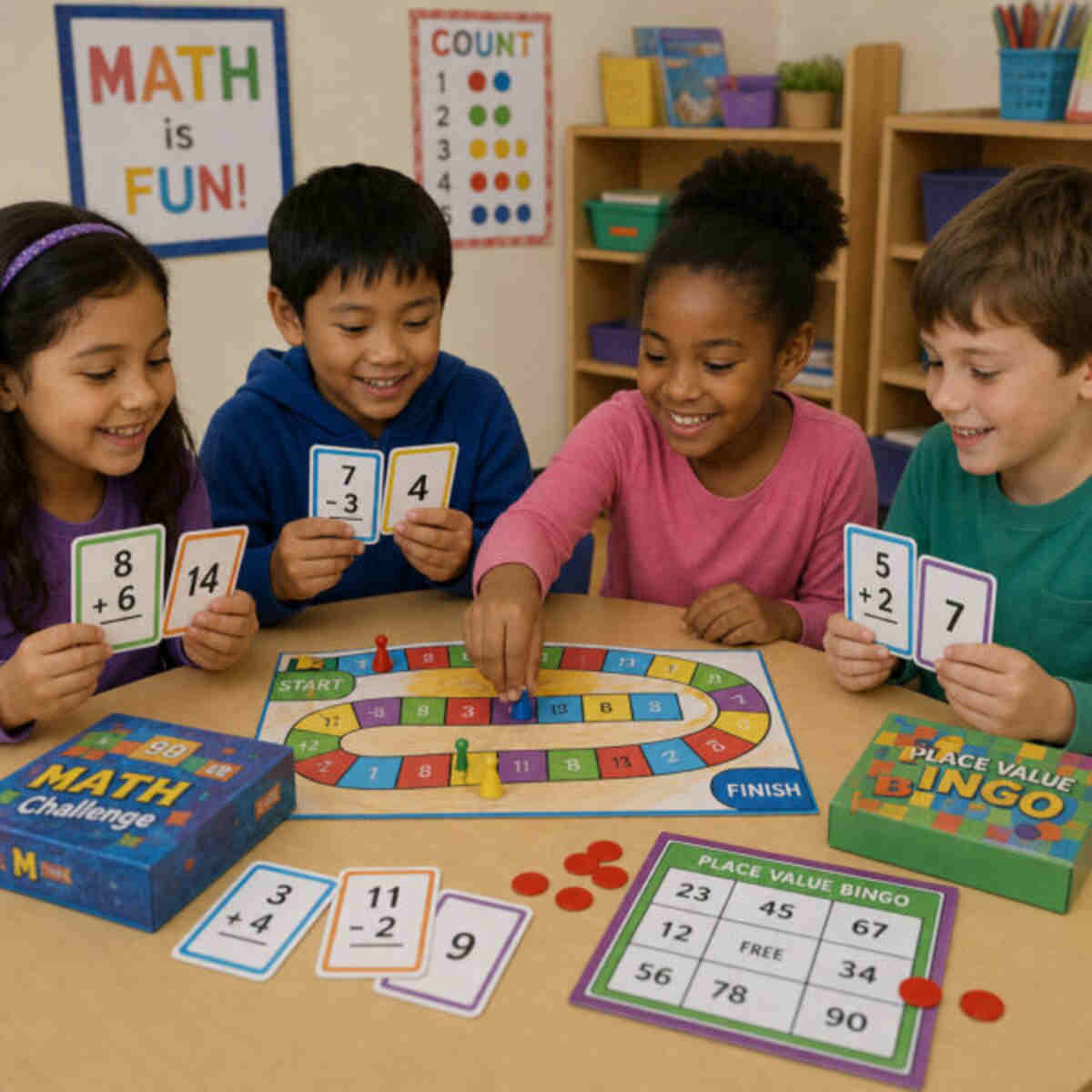
Turn practice time into playtime with a flexible collection of kid-friendly math games designed to help children build confidence, fluency, and problem-solving habits without the heavy “worksheet mood.” This product gives parents, teachers, tutors, and homeschool families a playful way to support essential math skills through short, engaging activities that feel approachable from the first round. Look into the Best info about pestoto slot.
Whether a child needs extra number-sense practice, a more enjoyable review routine, or a fresh alternative to screen-heavy distractions, these educational games are designed to make math feel less like a hurdle and more like a challenge worth trying.
What makes these math games useful for kids?
These games are useful because they connect math practice to action, choice, and visible progress. Instead of asking children to stare at a page of problems, they invite them to count, compare, match, estimate, solve, explain, and try again in a format that feels like play. That shift matters: when the activity is enjoyable, children are more willing to stay with the skill long enough to improve.
The collection is designed for everyday learning moments. Use it after school, during homeschool lessons, in a classroom math center, for tutoring warm-ups, or as a family game-night option with a learning purpose. It works especially well when a child understands the basics but needs more repetition, or when they feel nervous about math and need a softer, more encouraging way back in.
If you arrived here after searching for terms like math cool games papa, educational games, or math games, you are likely looking for something simple: math practice that does not feel dull, confusing, or punishing. This product is built for exactly that kind of search intent. It gives children meaningful practice while giving adults a practical tool they can use without overplanning.
Product overview
This math game collection is a child-centered learning resource for practicing core math concepts through repeatable game formats. Each activity focuses on making children think, respond, and participate instead of passively memorizing facts. The goal is not to replace instruction; the goal is to make practice more active, more memorable, and more enjoyable.
The product is suitable for families and learning environments where children need variety. Some kids enjoy competitive rounds, some prefer cooperative play, and others need calm solo challenges before they are ready to join a group. A strong math game routine gives room for all three. That flexibility helps adults meet children where they are rather than forcing every learner into a single practice style.
Because exact product versions, grade ranges, and formats may vary, review the available purchase options before making a choice. Select the format that best fits your setting, whether you need a home-friendly set, a classroom resource, a printable version, or, if offered, a digital activity pack.
Designed for fun, built for practice
A good learning game does more than decorate math with bright colors. It gives children a reason to use the skill. In these games, numbers are not isolated facts floating on a page; they become decisions inside a round, clues in a puzzle, moves in a challenge, or scores to compare.
That is where the learning value lives. A child may practice addition while trying to reach a target number, use subtraction while moving backward on a game path, compare quantities to decide the best move, or identify patterns to win a matching round. The game creates the situation, and math becomes the tool that helps the child move forward.
For adults, this means less coaxing and more coaching. Instead of saying, “Finish these problems,” you can say, “Try one more round,” “Explain how you got that,” or “Can you find another strategy?” Those small language changes make practice feel more human and give children space to talk about math rather than simply be marked right or wrong.
Key features
The strongest feature of this product is its blend of structure and play. Children get guided practice, while adults get an activity that can be used in short bursts or longer sessions. The games can support review, enrichment, remediation, and confidence-building depending on how they are introduced.
Core features may include:
- Game-based math practice that turns repetition into rounds, challenges, matches, or puzzles.
- Kid-friendly instructions written to reduce confusion and help children begin quickly.
- Skill-focused activities that can support counting, number sense, basic operations, patterns, logic, comparison, and problem solving.
- Flexible use cases for home, homeschool, tutoring, classroom centers, small groups, or independent practice.
- Replayable formats so children can practice the same concept more than once without feeling as if they are repeating the same worksheet.
- Low-pressure learning moments that help hesitant learners participate without the stress of a test-like setting.
- Opportunities for math talk through explaining moves, comparing strategies, and checking answers together.
- Simple adult guidance so parents and educators can use the games without needing to create a full lesson from scratch.
These features are intentionally practical. The best educational games are not the ones that sound impressive but sit unused; they are the ones a busy adult can actually pull out, explain, and repeat.
Benefits for children
Children often need repeated exposure before a math skill feels natural. The challenge is that repetition can become boring quickly. Games solve that problem by creating a reason to keep practicing. Each round gives the learner another chance to use the same skill in a slightly different way.
For children who already like math, the games can add challenge and variety. They can test strategies, race against a timer if that option is used, or try to beat a previous score. For children who struggle, the games can lower the emotional temperature. A wrong answer becomes part of the round, not a final judgment on ability.
Children may benefit from:
- Greater confidence because practice feels approachable and repeatable.
- Improved fluency through repeated use of math facts and number relationships.
- Better focus because the game format gives a clear goal and next step.
- Stronger reasoning as children explain moves, compare answers, and notice patterns.
- More willingness to try because the activity feels playful rather than punitive.
- Healthy persistence as children learn that a mistake can lead to a better next move.
- More positive math associations when practice is connected to success, laughter, and discovery.
The deeper benefit is as much emotional as it is academic. When children feel capable, they engage more. When they engage more, they practice more. When they practice more, they improve—and that improvement helps build the next layer of confidence.
Benefits for parents, teachers, and tutors
Adults need resources that save time without lowering quality. A strong set of math games can become part of a repeatable routine: warm up with a quick round, review a lesson with a matching game, reinforce facts after dinner, or give early finishers a purposeful activity that does not feel like extra work.
For parents, the product can make home practice less tense. Many families know the familiar scene: a child resists homework, an adult pushes, and math becomes a nightly battle. A game-based approach gives both sides a better starting point. The adult can still support learning, but the interaction feels more like shared play than correction.
For teachers and tutors, the games can support differentiation. One child may need counting practice while another is ready for strategy and logic. By choosing the right activity and adjusting the level of support, adults can make the same learning time feel more personalized.
Practical advantages include:
- Less preparation time than building a new activity from scratch.
- More student participation because games naturally invite response and movement.
- Easier review sessions for children who need practice, not another lecture.
- Better small-group energy because children can learn from one another’s strategies.
- Clearer observation opportunities as adults watch how a child thinks through a problem.
- Reusable learning value across multiple sessions, children, or skill goals.
A well-chosen educational game becomes more than a filler activity. It becomes a bridge between instruction and mastery.
Skills children can practice
Math confidence grows when children see how concepts connect. A child who understands number patterns can move more easily into addition. A child who can compare quantities has a stronger foundation for place value. A child who explains a strategy is already building the kind of reasoning needed for word problems and multi-step tasks.
Depending on the specific games or pack selected, children may practice skills such as:
- Counting forward and backward.
- Recognizing numbers and quantities.
- Matching numerals to sets or values.
- Comparing greater than, less than, and equal amounts.
- Addition and subtraction facts.
- Early multiplication or grouping concepts when appropriate.
- Patterns, sequences, and logical thinking.
- Mental math strategies.
- Estimation and checking reasonableness.
- Problem-solving language, including “how,” “why,” and “what if.”
The important point is that the games make these skills active. Children are not only finding an answer; they are using an answer to make a decision. That is a powerful difference, especially for learners who need math to feel concrete before it feels comfortable.
A better routine than “just one more worksheet”
Worksheets have their place, but they are not the only way to practice. Many children become more engaged when math is connected to movement, color, friendly competition, storytelling, or choice. A game-based routine adds that missing spark while still keeping the learning goal in view.
Imagine a child who usually freezes when faced with a full page of arithmetic. Now imagine the same child drawing a card, solving one problem to move ahead, and hearing, “Good strategy—how did you know?” The skill is still there, but the setting has changed. Instead of being overwhelmed by volume, the child handles one meaningful problem at a time.
That is the before-and-after promise of strong math games. Before, practice can feel like pressure. After, practice becomes a series of small, winnable moments. Those moments add up.
What is included
The exact contents depend on the version or package selected, so always check the purchase details before ordering. In general, a math game product page should help you choose the format that matches your child, schedule, and learning environment. The goal is to give you enough structure to start quickly and enough flexibility to reuse the games often.
Your selected option may include items such as:
- A collection of math game activities.
- Simple setup instructions for adults.
- Student-facing directions or prompts.
- Printable or digital game materials, if available.
- Skill labels or activity categories to help you choose the right game.
- Suggestions for solo, partner, small-group, or family play.
- Challenge variations to make activities easier or harder when provided.
- Practice formats that support review, fluency, and problem-solving.
This structure helps prevent the common problem of buying a learning resource and then not knowing where to begin. A useful product should make the first session feel clear, not complicated.
How to use the games at home
Home practice works best when it is short, consistent, and emotionally calm. You do not need to turn the living room into a classroom. You need a simple routine that children can predict and adults can sustain.
Start with one game and one skill. If your child is practicing addition, choose an activity that uses addition repeatedly in a playful way. Keep the first session short enough that the child finishes while still interested. Ending on a good note makes it much easier to return the next day.
A simple home routine can look like this:
- Choose the skill. Pick one focus, such as counting, addition facts, subtraction, or patterns.
- Set a short time window. Ten to fifteen minutes is often more useful than a long session that becomes tiring.
- Explain the goal. Tell the child what they are practicing and how the game works.
- Play one round together. Model your thinking out loud so the child can hear the strategy.
- Let the child take the lead. Step back when possible and coach only when needed.
- Celebrate a specific effort. Praise the strategy, persistence, or careful checking, not only the correct answer.
- Repeat later. Repetition is where growth happens, but it works best when it feels manageable.
This kind of routine is especially useful for families searching for educational games that do more than entertain. The activity still feels fun, but the adult knows exactly what skill is being strengthened.
How to use the games in classrooms or tutoring
In learning environments, time is precious. Games need to be easy to explain, quick to reset, and purposeful enough to justify their place in the lesson. This product can support review stations, partner practice, early finisher activities, intervention sessions, and tutoring warm-ups.
For classroom use, group students according to the skill they need to practice. One group may work on number recognition while another practices fact fluency or strategy-based comparison. Rotate games over time so students get repeated practice without the station feeling stale.
Tutors can use the games as a diagnostic window. Watch how a child approaches each turn. Do they count one by one? Do they use known facts? Do they guess quickly? Do they check? These observations help an adult know what to teach next.
Classroom and tutoring use cases include:
- Math centers for focused small-group practice.
- Warm-up games before direct instruction.
- Exit practice after a new concept is introduced.
- Intervention sessions for learners who need more repetition.
- Enrichment challenges for students ready to extend a skill.
- Partner games that promote math language and peer explanation.
- Calm review activities before assessments or transitions.
The product works best when the adult connects each game to a clear purpose. Children can play, but they should also know what math muscle they are building.
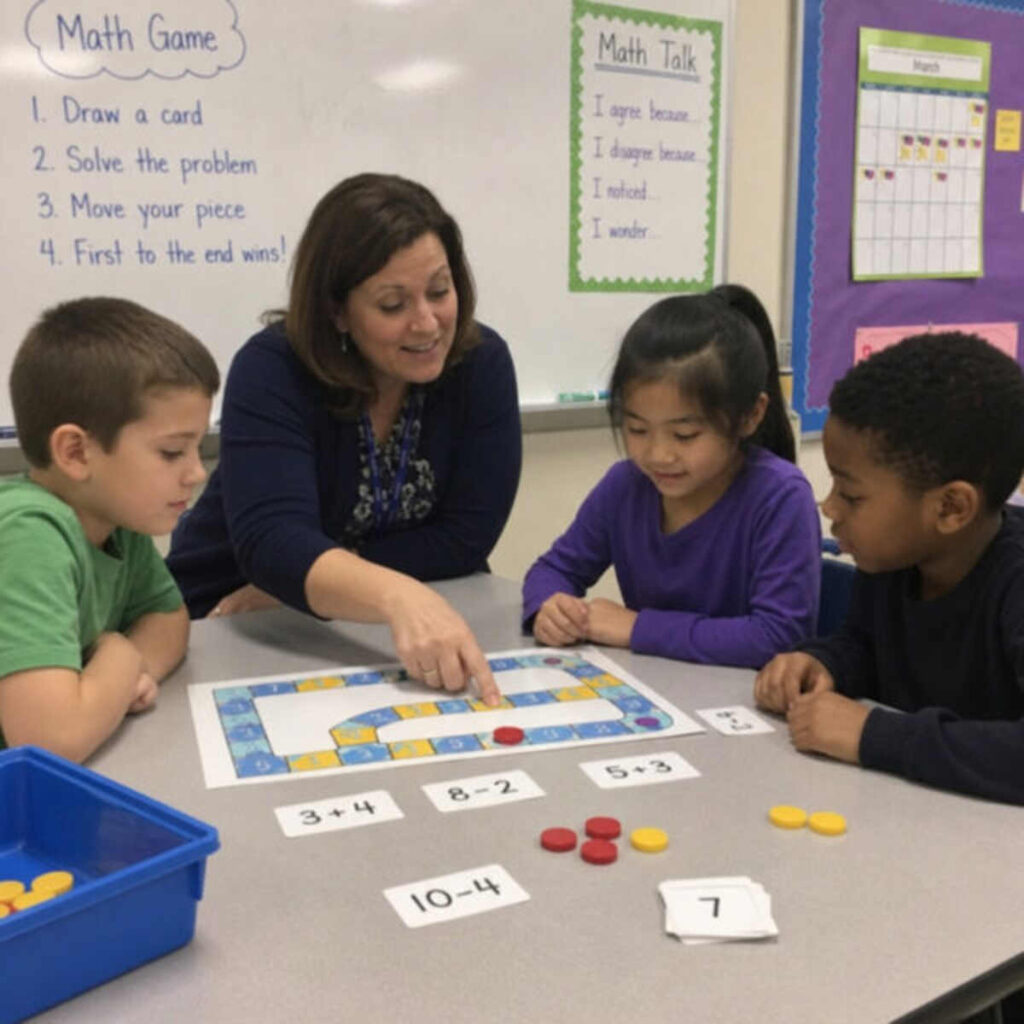
Why game-based learning works
Children learn by doing. When they manipulate pieces, choose cards, compare values, or explain a move, they create stronger connections than they often do through passive review alone. Games also give immediate feedback. A move works, a total changes, a pattern appears, or another player asks a question.
Game-based learning supports attention because the next action is visible. Children know when it is their turn, what the goal is, and how progress is measured inside the activity. This structure helps reduce the vague frustration that can come with open-ended practice.
It also supports resilience. In a traditional assignment, a wrong answer may feel permanent. In a game, a wrong answer can become part of the play cycle: check it, adjust, and continue. That rhythm teaches children that math is not about never making mistakes; it is about thinking carefully enough to recover from them.
Built for different learning styles
Children do not all approach math the same way. Some need to see the numbers. Some need to say the steps aloud. Some need to move pieces, draw patterns, or repeat a skill many times before it clicks. A varied collection of math games offers multiple entry points.
Visual learners may benefit from cards, colors, patterns, or arranged quantities. Verbal learners may benefit from explaining why a move is correct or discussing strategy with a partner. Kinesthetic learners may benefit from handling materials, moving tokens, or physically organizing numbers.
This flexibility is one reason math games can be so effective in mixed-skill settings. Instead of presenting math in only one form, the game gives children more ways to engage. That does not mean every activity fits every child perfectly, but it does give adults more options than a single worksheet format.
Product specifications
Because no single format has been specified, specifications should be confirmed on the purchase option you select. This section helps you know what to look for before buying, so you can choose the version that best fits your home or learning environment.
Review the product details for:
- Recommended age or grade range, if listed.
- Math skills covered, such as counting, operations, comparison, logic, or problem solving.
- Format, including printable, digital, physical, or bundled options if available.
- Number of games or activities included in your selected package.
- Materials needed: dice, counters, cards, pencils, or printed pages.
- Setup time, especially if you need quick-start activities.
- Group size: solo play, partner play, small group, or family use.
- Adult guidance level, including whether children can play independently once they have learned the rules.
- Access or delivery details, such as download instructions or, when applicable, shipping information.
This checklist helps you avoid choosing a resource that looks appealing but does not meet your actual needs. The right version should fit the child, the setting, and the amount of adult support available.
Purchase options and pricing
Pricing and package details should be confirmed at checkout or on the current product listing. Since offers can vary by format, bundle, license, or delivery method, the most reliable choice is to review the available purchase options before ordering. Look for the package that gives you the right balance of skill coverage, ease of use, and repeatable value.
Common purchase considerations include:
- Whether you need a single-child home option or a broader classroom-friendly version.
- Whether printable, digital, or physical materials are best for your setting.
- Whether the product includes enough activities for repeated practice.
- Whether any license terms match your intended use.
- Whether the selected option includes updates, extra levels, or bonus materials if offered.
- Whether the checkout page clearly explains delivery, access, and refund terms.
If you are buying for one child, choose the version that solves the most immediate practice need. If you are buying for a group, choose the option that offers flexibility across skill levels and repeated sessions.
Who this product is best for
This product is best for adults who want math practice to feel more inviting without losing educational purpose. It is not only for children who struggle, nor only for children who already love numbers. It sits in the useful middle: playful enough to engage, structured enough to teach, and flexible enough to fit different routines.
It may be a good fit for:
- Parents who want less stressful math practice at home.
- Homeschool families building a hands-on math routine.
- Teachers setting up math centers or review stations.
- Tutors who need quick, skill-focused warm-ups.
- Children who resist worksheets but enjoy games.
- Children who need repeated practice to build fluency.
- Children who benefit from visual, verbal, or hands-on learning.
- Families looking for learning activities that feel fun enough for repeated use.
It may not be the best fit if you need a full math curriculum, formal assessment system, or highly specialized intervention program. These games are designed for practice, reinforcement, engagement, and confidence-building. They work best alongside clear instruction and adult encouragement.
Common search needs this page answers
People searching for cool math games, papa, educational games, and math games often want a resource that feels safe, useful, and easy to start with. Some are parents trying to help a child who says math is boring. Some are teachers looking for classroom activities that do not require hours of preparation. Some are tutors seeking a better way to start sessions with energy.
This product page is built around those needs. It explains what the product does, how it helps, where it can be used, and what to check before buying. It also avoids the empty promise that a game alone will magically solve every math challenge. Good games support learning; they do not replace patient teaching, clear explanations, and steady practice.
If your goal is to make math feel more doable, this product gives you a practical starting point. If your goal is to make practice more consistent, it gives you repeatable activities. If your goal is to help a child feel less defeated, it offers a gentler way to reintroduce the skill.
A closer look at the learning experience
The experience begins with a clear task: match, count, solve, compare, move, or choose. That clarity is important because children often disengage when they do not understand what is expected. A game gives the task a visible frame, which makes the child’s next step easier to recognize.
Then the child makes a decision. They may choose a number card, add two values, compare totals, or explain a pattern. This decision-making is where math comes into play. The child is not simply completing a problem because an adult assigned it; they are using math to participate in the game.
Finally, the child receives feedback. The answer may move them ahead, complete a match, reveal a strategy, or invite correction. Over time, this cycle builds fluency. The child sees that math is not a mysterious wall but a series of choices that can be practiced and improved.
Ways to adjust the challenge
One of the most useful qualities of a math game is that it can often be adjusted. A child who is just beginning may need smaller numbers, fewer choices, or adult modeling. A child who is ready for more may need larger numbers, faster rounds, or an added strategy rule.
You can adjust challenge by:
- Using smaller or larger numbers.
- Playing with or without a timer.
- Allowing counters, drawings, or number lines for support.
- Asking children to explain their thinking after each turn.
- Requiring mental math for advanced practice when appropriate.
- Turning a competitive game into cooperative play.
- Reducing the number of cards, pieces, or steps for beginners.
- Adding a bonus challenge for children who finish quickly.
These adjustments help keep the product useful over time. Instead of outgrowing the game after one session, children can return to the same format with a new level of challenge.
Confidence is part of the product value
Math anxiety can start early. A child who feels slow, confused, or embarrassed may begin avoiding math before they have had enough successful practice. That is why a supportive format matters. The emotional setting of learning often shapes whether a child is willing to try again.
These games can help create more positive math moments. They give children a reason to participate, a structure for trying, and a chance to improve through repetition. When adults respond with encouragement and strategy-focused feedback, the game becomes more than an activity; it becomes a confidence-building conversation.
Use phrases like:
- “Show me how you figured that out.”
- “What strategy could you try next?”
- “You checked your answer carefully.”
- “That mistake helped us find the right path.”
- “Let’s play one more round and try a new approach.”
That language teaches children that math success is not about speed alone. It is about thinking, testing, revising, and growing.
Simple setup for busy adults
A learning product should respect adult time. Parents are busy. Teachers are managing full classrooms. Tutors have limited session minutes. Homeschool families are balancing multiple subjects. The easier a resource is to start, the more likely it is to be used consistently.
Before the first session, choose one activity and read the directions. Gather any materials listed in the product details. If the game includes levels, begin with the easiest version so the child can learn the rules before facing the full challenge. Once the routine is familiar, increase difficulty gradually.
A quick-start setup can follow this pattern:
- Select one game.
- Identify the skill it practices.
- Prepare only the materials needed for that game.
- Model one turn.
- Play a short round.
- Ask one reflection question.
- Save the game for reuse.
This keeps the experience clean and manageable. The adult does not need to overexplain, and the child does not need to master everything at once.
Make screen time more purposeful if using digital games
If the selected product includes digital activities, the goal should be purposeful engagement rather than endless clicking. Digital math games can be useful when they give children immediate feedback, clear goals, and skill-based challenges. They are less useful when they distract from the learning objective.
To make digital play more productive, set a time limit and a skill focus before the session begins. Sit nearby for the first few minutes to confirm that the child understands what to do. Afterward, ask the child to explain one strategy they used or one problem they solved.
For families searching broadly for “cool math games papa” or similar phrases, this distinction matters. Not every game that looks fun teaches well. Choose activities that make the child think, not just tap.
Make hands-on practice easier if using printable or physical games
If the selected product includes printable or physical materials, the key is organization. Store game pieces in labeled bags, folders, or small containers so setup does not become a barrier. Keep a few frequently used games accessible for quick practice sessions.
Hands-on games can be especially helpful for younger learners because they make abstract ideas visible. A child can see quantities, move pieces, group objects, and physically compare values. This concrete experience can make later symbolic work easier to understand.
To get the most value from hands-on play:
- Print or prepare only the games you plan to use soon.
- Keep small manipulatives nearby if the game allows them.
- Use clear storage so children can help with cleanup.
- Rotate games weekly to keep interest high.
- Revisit favorite games with harder numbers or new rules.
A prepared set of materials turns math practice into something you can start in minutes.
Why adults choose educational games for math practice
Adults choose educational games because they solve a real problem: children need practice, but practice often feels repetitive. A game gives repetition a purpose. It adds a goal, a rhythm, and a small emotional reward for continuing.
That does not mean every moment will be perfect. Children may still struggle, need help, or resist a challenging skill. But the game format gives adults more ways to respond. You can slow the round down, model a turn, switch to teamwork, or celebrate improvement rather than focusing only on the final score.
This makes games especially useful for skill-building that requires patience. Fact fluency, number sense, mental math, and problem-solving confidence all grow through repeated encounters. Games make those encounters easier to repeat.
Before you buy
Before purchasing, take a moment to match the product to your actual goal. A resource that is perfect for a classroom center may not be ideal for a five-minute homework break. A challenging strategy game may not be right for a child who still needs basic counting support.
Use this quick buying checklist:
- What skill does the child need to practice most right now?
- Does the selected product option match the child’s age or level?
- Can the adult explain the game quickly?
- Is the format practical for the setting?
- Will the child be able to replay the game more than once?
- Does the purchase option clearly state what is included?
- Are delivery, access, licensing, or usage terms clear before checkout?
- Does the game encourage thinking, not just guessing?
A smart purchase is not only about choosing the most colorful product. It is about choosing the resource you will actually use.
Getting started after purchase
Once you have access to the product, begin with a small win. Choose one game that matches a skill your child can almost do independently. The goal of the first session is not to test the child; it is to build familiarity with the format and create a positive association.
After the first round, ask the child what felt easy, what felt tricky, and what strategy helped. This quick reflection turns play into learning. It also gives you information for the next session.
For best results, build a simple weekly rhythm:
- Play one short round for review.
- Repeat a favorite game for fluency.
- Introduce one new challenge when the child is ready.
- Use supportive tools when needed.
- End with a specific compliment about effort or strategy.
Consistency beats intensity. A few focused rounds each week can be more sustainable than a long session that leaves everyone tired.
The value of playful repetition
Repetition is often misunderstood. Children do not need meaningless repetition; they need purposeful repetition. They need to meet the same skill often enough that it becomes familiar, but in ways that keep the brain engaged.
Games create variation inside repetition. The numbers, partner, target, or strategy may change. The core skill remains, but the experience stays fresh. That is exactly what many children need to move from “I sort of understand” to “I can do this.”
This is why math games are such a strong companion to instruction. Teaching introduces the concept. Practice strengthens it. Play helps children return to it willingly.
A practical product for real learning moments
The best learning resources fit real life. They work when a parent has fifteen minutes before dinner. They work when a teacher needs a center that students can understand. They work when a tutor wants to start with energy instead of anxiety. They work when a child needs another chance, but not another lecture.
This product is designed for those moments. It gives adults a purposeful way to invite children into math and children a more engaging path to practice. It is clear, flexible, and focused on the kind of learning that grows through use.
Choose your math game option
If you are ready to make math practice more engaging, review the available product options and select the version that best matches your child, classroom, tutoring plan, or homeschool routine. Check the current package details, format, pricing, and access information before purchase so you know exactly what you are getting.
Give children a math experience they can return to with curiosity instead of dread. Choose the game collection that fits your setting, start with one simple round, and turn today’s practice into a more confident tomorrow.
